

[Dec-2024] 410-101 Dumps With 100% Verified Q&As - Pass Guarantee or Full Refund
Pass Facebook 410-101 Exam With Practice Test Questions Dumps Bundle
NEW QUESTION # 22
What will determine the results of your campaigns on the Facebook platform?
Select all that apply.
Choose ALL answers that apply.
- A. Advertiser changes in audience, budget, placement, schedule, and optimization goals.
- B. Facebook Auction.
- C. Pacing system you set up.
- D. Whether you use Facebook Manager or the Fan Page to run ads.
Answer: A,B,C
Explanation:
Explanation
The Facebook main delivery system consists of three aspects:
* Auction: In the Facebook auction, you will be competing against thousands of advertisers worldwide.
They are all competing for one thing. End-users' space on the News Feed, Messenger, Audience Network, Video Ads, and mobile apps. It's just like a normal supply and demand function. The more advertisers competing for your time (demand), the more expensive it will become (supply). So the person willing to pay the most will get most impressions.
* Pacing System: Standard versus accelerated delivery makes a big difference in how your ads perform; especially in costs. Accelerated delivery will underperform your budget but allow you to spend your budget more quickly.
* Advertiser Controls: Obviously the size of your audience, budget, schedule, and type of ads will all affect the delivery of your ads.
Whenever you are running your campaigns, think of those three main areas with how they each will affect running your campaigns in the future.
NEW QUESTION # 23
An online membership site has built two different core/saved audiences in order to reach the same niche market through two different forms of segmentations.
Your social media manager has been running ads for 2 weeks, but it seems like one campaign is using 80% of the total budget.
When you compare both audiences, there is an 84% audience overlap.
What should you do next to optimize the campaign?
Choose only ONE best answer.
- A. You should unify both audiences into one, as your ad sets are competing with each other.
- B. You should stop using the audience where you are spending 20% of the budget.
- C. You should continue running the ads, as they are working properly.
- D. You should stop spending more money on the audiences where you have spent 80% of the budget.
Answer: A
Explanation:
Explanation
Whenever you have a high overlap between audiences, the best strategy is to unify both audiences.
If you use both audiences under one campaign in two separate ad sets, you are basically competing against yourself.
In other words, you are running two ads to the same audiences, so your costs and performance are not optimal.
Your best approach is to unify audiences and run one ad sets with two different ads.
NEW QUESTION # 24
Your client wants to launch a new mobile application for their online store.
Their primary product is the "PhotoSnap."
With PhotoSnap, you can upload photos on their website, change the pictures with filters, and print your pictures in different sizes. Customers pay for each image they print.
The product is doing really well, so they want to improve customer's experience by introducing a new mobile app.
Which Facebook tools should they use on their mobile app?
Select all that apply.
Choose ALL answers that apply.
- A. Comments
- B. Facebook Analytics for Apps
- C. Facebook Login
- D. Stories
- E. Account Kit
Answer: B,C,D,E
Explanation:
Explanation
Here is a full list of SDK tools you can use on mobile apps:
NEW QUESTION # 25
You've spent over $8,000 the first month of running campaigns. You go to your data and realize you are getting close to 4,000 Lead Events on the main landing page of the product; 300 Add To Cart Events; 121 Initiate Checkout; and 48 Purchase Events.
You tell your client that you will start running optimization campaigns for the second month.
Select all strategies that you should follow for the second month.
Choose ALL answers that apply.
- A. Run traffic campaign ads to people who have initiated the checkout process but have not finalized the purchase.
- B. Run conversion campaign ads optimized for the "Initiate Checkout Event" to people who have visited the main landing page of the product.
- C. Run conversion ads optimized for the "Lead Event" to core/saved audiences and exclude everyone who has visited the main landing page in the past 30 days.
- D. You run different conversion campaign ads for all events currently being measured on the website.
Answer: A,C
Explanation:
Explanation
You should never optimize conversion campaigns unless you have at least 500 events. The number of events you are getting at each stage of your funnel are key here:
* 4,000 Lead Events => you can run conversion campaigns to new audiences.
* 300 Add To Cart Events => you need to run traffic campaigns to custom audiences (web visitors).
* 121 Initiate Checkout Events => you need to run traffic campaigns to custom audiences (web visitors).
* 48 Purchase Events => you need to run traffic campaigns to custom audiences (web visitors).
Therefore, the only two strategies that apply in this case is to run conversion ads to new audiences to the "Lead Event" and traffic ads to people who have stayed at one of the other events to move them ahead in your client's online sales funnel.
NEW QUESTION # 26
What are some advantages for Facebook Pixel?
(Select all that apply)
Choose ALL answers that apply.
- A. Unlock additional advertising tools within Facebook.
- B. Evaluate your ROAS.
- C. Show to the right people, at the right moment, on the right devices.
- D. Build Core Audiences based on website visitors.
- E. Track cross-device conversions.
- F. Build audiences based on users who have installed your app.
Answer: A,B,C,E
Explanation:
Explanation
You can create a pixel, and connect it to your website, to:
* Make sure your ads are shown to the right people, on the right devices, at the right moment:
Knowing how people use your website can imply what they're likely to do next. This helps Facebook deliver ads to the people most likely to take the action you want them to take.
* Build effective advertising audiences: With Custom Audiences, you can show your ads to people based on how they've already interacted with your website. Using Lookalike Audiences, you can target ads to brand-new people based on their similarity to established visitors and customers.
* Measure cross-device conversions: See how customers move between devices while engaging with your content - and determine what devices they are most likely to convert on.
* Unlock additional Facebook advertising tools: Web conversion campaigns, Custom Audiences from your website, dynamic ad delivery, and metrics such as cost per lead or cost per conversion are only available to advertisers who've installed pixel on their websites.
* Better evaluate your return on ad spend by more precisely attributing online behaviors to your Facebook, Instagram, Messenger, and Audience Network ads.
Pixel can enable powerful, actionable, and cost-saving adjustments to ad delivery - such as only displaying brand awareness campaigns to people who've never visited your website, or offering limited-time discount codes to people who've abandoned online shopping carts.
NEW QUESTION # 27
Your client is launching an online course. From previous experience, they've realize that in order to maximize online sales, they need to run a campaign 1 month before with various 15-second long videos so that people familiarize with the new course.
Here are your campaign requirements for the campaign you are launching to build the awareness needed before converting users through the website:
* They want for people to show the video twice every 7 days
* You have a video creative 15-seconds long
* They want to optimize for video views
How should you set up the campaign?
Choose only ONE best answer.
- A. Buy through the auction, select the video view objective, optimize for ThruPlay and set a frequency of 2 every 7 days.
- B. Buy through the reach and frequency and set a frequency of 2 every 7 days.
- C. Buy through the auction, select the video view objective, optimize for 10-seconds view and set a frequency of 2 every 7 days.
- D. Buy through the auction, select the brand awareness objective and set a frequency of 2 every 7 days.
- E. Buy through the auction, select the reach objective and set a frequency of 2 every 7 days.
Answer: C
NEW QUESTION # 28
Your client is launching a new car nationwide.
They've come up with a marketing campaign that contains three different videos. They want to deliver the campaign to a large audience during a specific time frame.
What buying option should they use and how should you optimize your campaigns?
Choose only ONE best answer.
- A. Reach and Frequency, with Sequenced delivery, so that you run campaigns on specific dates.
- B. Ad Auction, with a brand awareness campaign, in order to maximize reach of the different campaigns.
- C. Reach and Frequency, with Scheduled delivery, so that you run campaigns on specific dates.
- D. Ad Auction, running multiple campaigns with specific dates so that it's targeted correctly.
Answer: C
Explanation:
Explanation
Whenever a customer is running a nationwide campaign, you want to go with "Reach and Frequency" option.
This buying option will allow you to control reach, frequency, and budget.
There are three ways you can optimize your video campaigns within the reach and frequency options:
* Standard
* Sequenced
* Scheduled
Below is a table with the differences for each:
In this case, you want to use the "Schedule" option as the client wants to run the campaign on specific dates.
NEW QUESTION # 29
You've recently installed the Facebook Pixel on a new website. You are not sure if the website is detecting your pixel events correctly.
What are some tools you can use to troubleshoot your pixel and make sure it's collecting your events properly?
(Select 3 that apply.)
Choose ALL answers that apply.
- A. You should install a second pixel and make sure it works properly
- B. You should install the Facebook Pixel Helper chrome extension to verify your pixel event.
- C. You should check your campaigns to see if they are showing events.
- D. You can track events and debug your pixel through Facebook's Analytics dashboard
- E. You can test your events in the "Events Manager" under your Business Manager
Answer: B,D,E
Explanation:
Explanation
There are three main ways in which you can debug your Facebook pixel:
1. Install the Facebook Pixel Helper chrome extension so you can see if the events are being tracked properly.
2. Go to your "Events Manager" page in your Business Manager and troubleshoot your pixel events
3. Use Facebook Analytics event debugging tool to troubleshoot it.
NEW QUESTION # 30
You are planning on running a brand lift study for your client, what are some of the metrics you can measure through the study?
Choose only ONE best answer.
- A. Percentage point lift, message association, and cost per click.
- B. Cost per click, cost per mile, percentage point lift, and video views.
- C. Percentage point lift, message association, favorability, and cost per click.
- D. Percentage point lift, cost per estimated incremental person who remembers your ads, and estimated incremental number of people who remember the ad.
Answer: D
Explanation:
Explanation
All brand lift studies will receive the following metrics by comparing the test (exposed) versus control groups:
* Estimated # of persons - is the estimated incremental number of people who remembered seeing your ad.
* Cost per incremental person - people who remembered seeing your ad (based on your budget).
* Percentage point lift - which is the difference in the percent of people who recall seeing your ad in the exposed group versus those in the control group.
All of these metrics will also be available for message association, favorability, and purchase intent.
Below is an example:
NEW QUESTION # 31
What strategies should you follow to accomplish your customer's goals?
Choose only ONE best answer.
- A. Use Facebook pixel, and cross-reference data from customer purchases with the pixel events to see results from Facebook campaigns.
- B. Use offline events to understand purchases at the retail stores and orders made from the phone.
- C. Use website conversion tracking to see how many people purchases at the store.
- D. Use offline events from the website, and cross-reference data to measure Facebook's impact.
Answer: B
Explanation:
Explanation
One of the most powerful tools to measure sales at retail stores is to use Facebook offline events. With Offline Conversion Tracking, you can track when transactions occur in a physical business location and other offline channel, after people see or engage with a Facebook ad.
* Use precise timestamps, including minutes and seconds to track multiple purchases.
* Use actual transaction value to see the most accurate event values on a dashboard.
* Use Order ID's or item number to include multiple items within a single transaction.
So the best strategy is to use offline events to better understand how Facebook marketing campaigns affect the retail stores.
NEW QUESTION # 32
You client would like to promote a new product with five different posts. You need to set up a campaign with different ads in order to test five videos for a specific audience. They would like to reach as many people as possible with their new campaign in order to maximize awareness of the new product launch.
Your community manager has selected post interaction campaign as the objective and gave each ad set a budget of $900.
After a week of running the campaign you see the following results:
You still have $4,500 in your campaign budget to spend over the course of the next two weeks. How do you optimize your campaign?
(Select all that apply)
Choose ALL answers that apply.
- A. You should decrease your budget to $3,000
- B. You should increase the budget from ad #5
- C. You should use budget optimization for your campaign.
- D. You should switch your campaign objective from post interaction to brand awareness.
- E. You should delete all ad sets and have leave just one.
- F. You turn off Ad #1
- G. You should switch the budget from ad #4 to ad #2.
Answer: C,D,E,F
NEW QUESTION # 33
Estimated Ad Recall Lift is shown in the Results Manager for which objectives?
Choose ALL answers that apply.
- A. Video Views
- B. Post Engagement
- C. Brand Awareness
- D. Conversions
- E. Store Visits
Answer: A,B,C
Explanation:
Explanation
Metric: Estimated Ad Recall Lift (people)
An estimate of the number of additional people who may remember seeing your ads, if asked, within two days.
This metric shows results for ads using Brand Awareness, Video Views, and Engagement - Post Engagement objectives.
NEW QUESTION # 34
Your client has been running a retail shop for the past 20 years.
In order to grow sales, they want to launch a new online store where people can buy products directly on their website. They can share with you a customer database of 20,000 customers who have bought a product in the past 2 years.
For the campaign, you need to reach out to existing customers, and people within a 10-mile radius from the stores.
What type of audiences should you build?
Choose only ONE best answer.
- A. You should do a similar audience with the customer database, and then, launch a reach campaign to people in a 10-mile radius.
- B. You should first do a custom audience with the database, and then, a similar audience optimized for reach.
- C. You should first, do a custom audience with the database, and a similar audience optimized for similarity.
Then use the similar audience as a base for a new core/saved audience, and reduce the similar audience to a 10-mile radius from the stores. - D. You should first do a custom audience with the database, and then, a similar audience optimized for similarity.
Answer: C
Explanation:
Explanation
The first audience you need to build is the custom audience with the customer database. This audience will allow you to reach out to existing customers and run campaigns to the website.
The second audience you need to build is a similar audience with the customer database. Since you have a
20,000 baseline, you should be able to build a really good similar audience optimized for similarity.
Keep in mind that you are looking for quality over quantity in this particular case. You should select a 1% audience size.
* Choose an audience size close to 1 to optimize for similarity. Your Lookalike Audience will likely be small, with a high resemblance to your seed.
* Choose an audience size close to 10 to optimize for reach. Your Lookalike Audience will be larger,
* but less similar to your seed.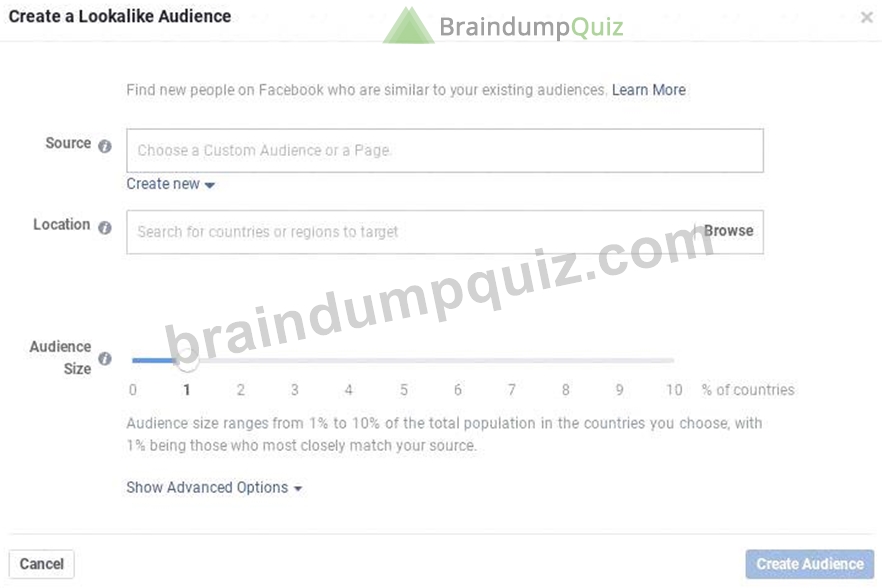
There is a third, very important, step that still needs to be done. You need to use the similar audience you've just built and then re-segment that for the 10-mile radius.
This new saved/core audience based on a similar audience should be your best option for reaching out to new potential customers.
NEW QUESTION # 35
You want to share the different campaign options you've built in the Campaign Planner with your customer.
What are some of the different ways you can share them?
Select all that apply.
Choose ALL answers that apply.
- A. You can't share campaigns in the Campaign Planner.
- B. You can send a link directly from the Campaign Planner for them to see.
- C. Send an email that includes the details of the campaigns and links to it.
- D. You can send them the CSV file of your campaigns through email.
Answer: B,C,D
Explanation:
Explanation
There are three different ways you can primarily share your campaigns with the Campaign Planner:
* Send an email that includes the major details of the Plan and links to it.
* Send a shareable link to the Plan.
* Export a CSV of the Versions of your Plan.
NEW QUESTION # 36
You just hired a new social media manager. You need to run a campaign on Instagram based on people who've downloaded a tripwire on your company's website.
The new person need to be able to create audiences and conversion ads for the campaigns you are about to launch. What roles should you give the new person?
Choose only ONE best answer.
- A. Pixel Moderator
- B. Pixel Event Manager
- C. Pixel Editor
- D. Pixel Ad Manager
- E. Pixel Standard Access
Answer: C
Explanation:
Explanation
Once you create a Facebook pixel, you can share it with other people in your business. You can give other people access to a Facebook pixel by adding them to either a specific ad account or by granting pixel access to individual people.
If someone is a part of your business, but doesn't have access to an ad account that's in your business, they'll no longer be able to access pixels associated with that ad account. You'll need to either add this person to your pixel, or add them to the ad account associated with the pixel you'd like them to be assigned to. If you want to view or edit a pixel, you'll need to be added to a pixel or a specific ad account by a Business Manager Admin.
You can also request access to the ad account associated with a pixel.
There are currently only two roles within the pixel:
* Pixel Editor: Pixel Editors can view information about a pixel and make changes to the pixel. Pixel Editors can also create audiences and conversion ads with the pixel.
* Pixel Analyst: Pixel Analysts can only view information about a pixel. Pixel Analysts can't edit the pixel, create audiences or conversion ads with the pixel.
IMPORTANT: Even though Facebook uses "Pixel Editor" as a role in its website, within the tool you have two options to choose from:
* Standard Access
* Admin Access
NEW QUESTION # 37
You have just gotten the results from a conversion campaign you ran for a membership site for 2 weeks:
There were 9 new customers acquired through the campaign.
Customers usually pay 6 months on average.
The monthly membership fee is $15.
The total amount you spent on the campaign was $400.
What is the ROAS for this campaign?
Choose only ONE best answer.
- A. -$265
- B. $102.50
- C. $265
- D. $410
Answer: D
Explanation:
Explanation
Return on Ad Spend (ROAS) measures gross revenue generated directly for every dollar spent on the advertising campaign:
ROAS = Revenue From Ad Campaign / Cost Of The Ad Campaign
A more accurate way to calculate ROAS when you have recurring revenue is with the following formula:
ROAS = (# of new customers acquired from Campaign x LTV of a New Customer) - Cost of Ad Campaign In this case, you would need the following info:
# of new customer => 9
LTV of new customers => 6 * $15 = $90
Cost of Ad Campaign => $400
ROAS = 9 * $90 - $400 = $410
NEW QUESTION # 38
Your client wants to launch a mobile application in Colombia and India. They have a budget of $15,000 for the mobile app launch.
Below are the specifications:
- They will initially launch only for Android devices.
- The app does not work with Tablets.
- The app is geared towards younger generation below 25 years.
What targeting options would you select to reach your niche market when creating a core/saved audience?
Select all that apply.
Choose ALL answers that apply.
- A. App Store Region
- B. Countries India + Colombia
- C. Interests: Gamers
- D. Mobile Device User - focused on Android
- E. Gender Male
- F. Age with max 25 years
Answer: B,D,F
Explanation:
Explanation
For this exercise, you need the following aspects in order to segment your core/saved audience:
1. Age: you definitely want to set up age below 25 years old.
2. Mobile Device User: you need to specify Android as the primary operating system for mobile in order to target just Android users and exclude iOS users.
3. Location: you want to target the specific countries. In this case, Colombia and India in order to reach out to people in those two particular places.
You don't want to use App Store Region as an option to segment as they don't allow you to select specific countries. You are better off selecting countries and Mobile Device User to segment.
The gender and interest for this exercise are irrelevant since you don't have more info on what the mobile app is about.
NEW QUESTION # 39
What are three metrics that video can have a huge impact on brands?
Select all that apply.
Choose ALL answers that apply.
- A. Brand Awareness
- B. Ad Recall
- C. Purchase Consideration
- D. Cost Per Click
Answer: A,B,C
Explanation:
Explanation
Facebook did a huge research back in 2015 to figure out how the video had an impact on brands when running campaigns.
To see the full report go to: The Value of Video for Brands
They realized that video ads could have a huge impact on three aspects from a user perspective:
1. Ad Recall
2. Brand Awareness
3. Purchase Intent
The more seconds people view a video, the better metrics got.
Keep in mind that you might get questions pertaining Brand Lift studies in your exam.
NEW QUESTION # 40
......
2024 Valid 410-101 test answers & Facebook Exam PDF: https://skillsoft.braindumpquiz.com/410-101-exam-material.html