

(Oct-2024) 300-710 Exam Dumps Contains FREE Real Quesions from the Actual Exam
Free Test Engine Verified By CCNP Security Certified Experts
Cisco 300-710 exam is considered to be one of the most challenging exams in the Cisco certification program. 300-710 exam requires a thorough understanding of Cisco Firepower solutions and the ability to implement and manage security policies effectively. Candidates who pass the exam will be recognized as experts in network security and will have a competitive advantage over other IT professionals in the job market.
Cisco 300-710 certification exam, also known as Securing Networks with Cisco Firepower, is designed to test the knowledge and skills of IT professionals in securing network infrastructures using Cisco Firepower technology. 300-710 exam focuses on the implementation, configuration, and management of Cisco Firepower Next-Generation Firewall (NGFW) and Cisco Firepower Management Center (FMC).
NEW QUESTION # 99
A network administrator configured a NAT policy that translates a public IP address to an internal web server IP address. An access policy has also been created that allows any source to reach the public IP address on port 80. The web server is still not reachable from the Internet on port 80. Which configuration change is needed?
- A. The NAT policy must be modified to translate the source IP address as well as destination IP address.
- B. The intrusion policy must be disabled for port 80.
- C. The access policy rule must be configured for the action trust.
- D. The access policy must allow traffic to the internal web server IP address.
Answer: D
NEW QUESTION # 100
Drag and drop the steps to restore an automatic device registration failure on the standby Cisco FMC from the left into the correct order on the right. Not all options are used.
Explanation
Answer:
Explanation:
NEW QUESTION # 101
A network administrator is trying to configure Active Directory authentication for VPN authentication to a Cisco Secure Firewall Threat Defence instance that is registered with Cisco Secure Firewall Management Center. Which system settings must be configured first in Secure Firewall Management Center to accomplish the goal?
- A. Policies, Authentication
- B. System, Realms
- C. Device, Remote Access VPN
- D. Authentication, Device
Answer: B
Explanation:
To configure Active Directory authentication for VPN authentication on a Cisco Secure Firewall Threat Defense (FTD) instance registered with Cisco Secure Firewall Management Center (FMC), the administrator needs to configure Realms in the System settings of the FMC. Realms in FMC are used to define the directory servers (e.g., Active Directory) and how they are used for user authentication.
Steps to configure this in FMC:
* Navigate to System > Integration > Realms and Directory.
* Add a new realm and configure the necessary details such as the directory server type (e.g., Active Directory), server address, and bind credentials.
* Test the connection to ensure it works correctly.
This setup allows the FMC to authenticate VPN users against the Active Directory, thereby enabling secure access control for VPN connections.
References: Cisco Secure Firewall Management Center Administrator Guide, Chapter on Realms Configuration.
NEW QUESTION # 102 
Refer to the exhibit. An engineer is analyzing a Network Risk Report from Cisco FMC. Which application must the engineer take immediate action against to prevent unauthorized network use?
- A. Chrome
- B. TOR
- C. Kerberos
- D. YouTube
Answer: B
NEW QUESTION # 103
A security engineer is configuring an Access Control Policy for multiple branch locations These locations share a common rule set and utilize a network object called INSIDE_NET which contains the locally significant internal network subnets at each location What technique will retain the policy consistency at each location but allow only the locally significant network subnet within the applicable rules?
- A. utilizing a dynamic ACP that updates from Cisco Talos
- B. creating an ACP with an INSIDE_NET network object and object overrides
- C. creating a unique ACP per device
- D. utilizing policy inheritance
Answer: B
NEW QUESTION # 104
Which action should be taken after editing an object that is used inside an access control policy?
- A. Redeploy the updated configuration.
- B. Delete the existing object in use.
- C. Create another rule using a different object name.
- D. Refresh the Cisco FMC GUI for the access control policy.
Answer: A
Explanation:
Section: Management and Troubleshooting
Explanation/Reference: https://www.cisco.com/c/en/us/td/docs/security/firepower/630/configuration/guide/fpmc-config- guide-v63/reusable_objects.html
NEW QUESTION # 105
The event dashboard within the Cisco FMC has been inundated with low priority intrusion drop events, which are overshadowing high priority events. An engineer has been tasked with reviewing the policies and reducing the low priority events. Which action should be configured to accomplish this task?
- A. drop packet
- B. generate events
- C. drop connection
- D. drop and generate
Answer: A
Explanation:
Reference" https://www.cisco.com/c/en/us/td/docs/security/firepower/620/configuration/guide/fpmc-config-guide-v62/working_with_intrusion_events.html
NEW QUESTION # 106
Refer to the exhibit.
A company is deploying a pair of Cisco Secure Firewall Threat defence devices named FTD1 and FTD2.
FTD1 and FTD2 have been configured as an active/standby pair with a failover link but without a stateful link.
What must be implemented next to ensure that users on the internal network still communicate with outside devices if FTD1 fails?
- A. Connect and configure a stateful link and thon deploy the changes.
- B. Disable port security on the switch interfaces connected to FTD1 and FTD2.
- C. Configure the spanning-tree PortFasI feature on SW1 and FTD2
- D. Set maximum secured addresses to two on the switch interfaces on FTD1 and FTD2.
Answer: A
Explanation:
In a failover configuration with Cisco Secure Firewall Threat Defense (FTD) devices, ensuring that users on the internal network can continue to communicate with outside devices if the primary device (FTD1) fails requires the implementation of a stateful failover link. The stateful failover link allows the secondary device (FTD2) to maintain session information and state data, ensuring seamless failover and minimizing disruptions.
Steps to implement a stateful failover link:
* Physically connect a stateful failover link between FTD1 and FTD2.
* Configure the stateful failover link in the FMC.
* Ensure that both devices are properly synchronized and that stateful failover is enabled.
* Deploy the changes to both FTD devices.
By configuring a stateful link, the secondary FTD can take over active sessions without requiring users to re-establish their connections, thus ensuring continuous communication.
References: Cisco Secure Firewall Threat Defense Configuration Guide, Chapter on Failover Configuration.
NEW QUESTION # 107
What is the advantage of having Cisco Firepower devices send events to Cisco Threat Response via the security services exchange portal directly as opposed to using syslog?
- A. All types of Cisco Firepower devices are supported.
- B. Supports all devices that are running supported versions of Cisco Firepower.
- C. Cisco Firepower devices do not need to be connected to the Internet.
- D. An on-premises proxy server does not need to be set up and maintained.
Answer: D
NEW QUESTION # 108
Which firewall design will allow It to forward traffic at layers 2 and 3 for the same subnet?
- A. Integrated routing and bridging
- B. routed mode
- C. transparent mode
- D. Cisco Firepower Threat Defense mode
Answer: C
Explanation:
Explanation
Transparent mode is a firewall configuration in which the firewall acts as a "bump in the wire" or a "stealth firewall" and is not seen as a router hop to connected devices. In transparent mode, the firewall can forward traffic at both layer 2 and layer 3 for the same subnet, as it does not perform any address translation or routing.
The firewall inspects the traffic and applies security policies based on the source and destination IP addresses, ports, and protocols. Transparent mode is useful when you want to deploy a firewall without changing the existing network topology or addressing scheme1.
NEW QUESTION # 109
What is a functionality of port objects in Cisco FMC?
- A. to represent all protocols in the same way
- B. to add any protocol other than TCP or UDP for source port conditions in access control rules.
- C. to mix transport protocols when setting both source and destination port conditions in a rule
- D. to represent protocols other than TCP, UDP, and ICMP
Answer: D
Explanation:
Reference: https://www.cisco.com/c/en/us/td/docs/security/firepower/620/configuration/guide/fpmc-config-guide-v62/reusable_objects.html
NEW QUESTION # 110
Which two remediation options are available when Cisco FMC is integrated with Cisco ISE? (Choose two.)
- A. DHCP pool disablement
- B. quarantine
- C. dynamic null route configured
- D. port shutdown
- E. host shutdown
Answer: B,D
NEW QUESTION # 111
An organization is using a Cisco FTD and Cisco ISE to perform identity-based access controls. A network administrator is analyzing the Cisco FTD events and notices that unknown user traffic is being allowed through the firewall. How should this be addressed to block the traffic while allowing legitimate user traffic?
- A. Add the unknown user in the Access Control Policy in Cisco FTD.
- B. Add the unknown user in the Malware & File Policy in Cisco FTD.
- C. Modify the Cisco ISE authorization policy to deny this access to the user.
- D. Modify Cisco ISE to send only legitimate usernames to the Cisco FTD.
Answer: A
NEW QUESTION # 112
What are the minimum requirements to deploy a managed device inline?
- A. passive interface, security zone, MTU, and mode
- B. inline interfaces, security zones, MTU, and mode
- C. inline interfaces, MTU, and mode
- D. passive interface, MTU, and mode
Answer: C
Explanation:
Reference:
https://www.cisco.com/c/en/us/td/docs/security/firepower/650/configuration/guide/fpmc-config- guide-v65/ips_device_deployments_and_configuration.html
NEW QUESTION # 113
Drag and drop the steps to restore an automatic device registration failure on the standby Cisco FMC from the left into the correct order on the right. Not all options are used.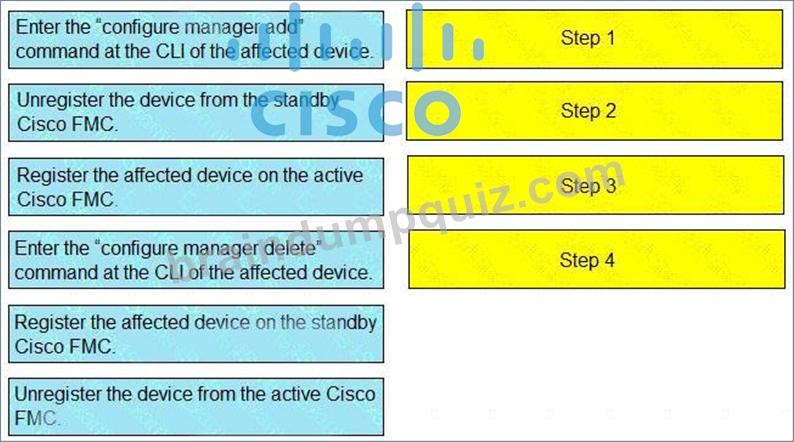
Answer:
Explanation:
Explanation
Explanation
Reference: https://www.cisco.com/c/en/us/td/docs/security/firepower/620/configuration/guide/fpmc-config-guide-v62/firepower_management_center_high_availability.html#id_32288
NEW QUESTION # 114
What is the RTC workflow when the infected endpoint is identified?
- A. Cisco AMP instructs Cisco FMC to contain the infected endpoint.
- B. Cisco FMC instructs Cisco ISE to contain the infected endpoint.
- C. Cisco ISE instructs Cisco FMC to contain the infected endpoint.
- D. Cisco ISE instructs Cisco AMP to contain the infected endpoint.
Answer: B
NEW QUESTION # 115
Which command should be used on the Cisco FTD CLI to capture all the packets that hit an interface?
- A. capture
- B. capture-traffic
- C. capture WORD
- D. configure coredump packet-engine enable
Answer: B
Explanation:
Reference:
https://www.cisco.com/c/en/us/td/docs/security/firepower/command_ref/ b_Command_Reference_for_Firepower_Threat_Defense/ac_1.html
NEW QUESTION # 116
A security engineer must configure a Cisco FTD appliance to inspect traffic coming from the internet. The Internet traffic will be mirrored from the Cisco Catalyst 9300 Switch. Which configuration accomplishes the task?
- A. Set interface configuration mode to passive.
- B. Set the firewall mode to transparent.
- C. Set the firewall mode to routed.
- D. Set interface configuration mode to none.
Answer: A
NEW QUESTION # 117
An administrator is attempting to remotely log into a switch in the data centre using SSH and is unable to connect. How does the administrator confirm that traffic is reaching the firewall?
- A. by running Wireshark on the administrator's PC
- B. by running a packet tracer on the firewall.
- C. by attempting to access it from a different workstation.
- D. by performing a packet capture on the firewall.
Answer: D
NEW QUESTION # 118
......
Earning the Cisco 300-710 certification demonstrates that a candidate has the skills and knowledge needed to secure Cisco networks using Firepower technologies. It can help IT professionals advance their careers and open up new job opportunities in network security.
Use Real Cisco Achieve the 300-710 Dumps - 100% Exam Passing Guarantee: https://skillsoft.braindumpquiz.com/300-710-exam-material.html