

Best Value Available! 2023 Realistic Verified Free 1z0-1056-22 Exam Questions
Pass Your Exam Easily! 1z0-1056-22 Real Question Answers Updated
NEW QUESTION 51
Which reporting tool is primarily used by users to create ad hoc analysis from real-time Receivables data?
- A. XML Publisher
- B. Oracle Transaction Business Intelligence
- C. Smart View
- D. ADFdi Spreadsheets
- E. Financial Reporting Web Studio
Answer: B
NEW QUESTION 52
Identify two credit memo options. (Choose two.)
- A. Tax only
- B. Paid freight
- C. Advance
- D. Invoice lines
- E. Paid amount only
Answer: A,D
NEW QUESTION 53
Which transactions are included when transactions of specified customers are selected in the Create Balance Forward Billing Program?
- A. transactions that have the Print Option set to Do Not Print
- B. transactions have a Bill Type of Imported
- C. transactions that have the selected payment terms
- D. transactions that were included in a previous Balance Forward Bill
Answer: C
NEW QUESTION 54
Which three transaction types are used to generate late charges? (Choose three.)
- A. Cash Receipts
- B. Interest Invoice
- C. Adjustments against the original transaction
- D. Debit Memo
- E. Credit Memo
Answer: B,C,E
Explanation:
Reference: https://docs.oracle.com/cloud/latest/financialscs_gs/FAIRP/FAIRP1476421.htm
NEW QUESTION 55
As an implementer, while importing data from the legacy/third-party system, you forgot to populate the accounting distribution in the RA_INTERFACE_DISTRIBUTIONS_ALL table.
What happens when you run accounting?
- A. Invoice will be created and the system will use auto accounting configuration to create accounting.
- B. It will return an error and the data will be stuck in the interface table.
- C. Invoice will get created but accounting won't be created.
- D. Neither invoice nor accounting will be created.
Answer: A
NEW QUESTION 56
When reversing a receipt, if an adjustment or chargeback exists, how are the off-setting adjustments created?
- A. automatically by using the Adjustment Reversal and Chargeback Reversal activities
- B. manually, but without using the Adjustment Reversal and Chargeback Reversal activities
- C. manually by using Chargeback Reversal activities
- D. manually by using Adjustment Reversal activities
- E. automatically, but without using the Adjustment Reversal and Chargeback Reversal activities
Answer: A
Explanation:
When you reverse a receipt, if an adjustment or chargeback exists, Receivables automatically generates off-setting adjustments using the Adjustment Reversal and Chargeback Reversal activities.
NEW QUESTION 57
You have created a sales invoice for $900 USD with an item line of $750 USD and a tax rate of 20%. The customer has made a payment of $500 USD and you are required to process the cash application to apply the $500 USD to the item line and $0 USD to tax.
How would you achieve this?
- A. Set the credit classification revenue recognition policy to look for Line First and Tax Later.
- B. Create a Memo Line or receivable activity to have the check box selected for Apply Item Line First.
- C. Set Application Rule Set to Line First--Tax After at the transaction source level and/or a default value at the receipt method.
- D. Set the payment terms revenue recognition policy to look for Line First and Tax Later.
- E. Set Application Rule Set to Line First--Tax After at the transaction type level and/or a default value at system options.
Answer: E
NEW QUESTION 58
After a customer bankruptcy is approved, what happens in the Collections application?
- A. Collection activities remain active, delinquent transactions appear in the Collections Work Area but customer status is changed to Bankrupt.
- B. The Bankrupt Customer Collection job is automatically submitted to close all open transactions for the customer.
- C. Collection activities are suspended, delinquent transactions no longer appear on the Collections Work Area and customer status is changed to Bankrupt.
- D. Collection activities are suspended and delinquent transactions appear in the Collections Work Area.
Answer: C
NEW QUESTION 59
Identify two values that default from Customer Profile Classes. (Choose two.)
- A. Statement Cycle
- B. Payment Terms
- C. Legal Entity
- D. Business Purpose
- E. Tax
Answer: B,E
NEW QUESTION 60
When deciding how to set up the system to recognize revenue, it is important to understand the extent of revenue deferral and the subsequent timing of revenue recognition.
Which two statements are true when you consider that recognition depends on the nature of the contingency? (Choose two.)
- A. Post-billing customer acceptance clauses must expire (implicit acceptance), or be manually accepted (explicit acceptance), before the contingency can be removed and revenue recognized.
- B. Payment-based contingencies do not always require payment before the contingency can be removed and revenue recognized.
- C. Pre-billing customer acceptance clauses require the recording of customer acceptance in the feeder system, or its expiration, before importing into Receivables for invoicing. Customer acceptance or its expiration must occur before the contingency can be removed and the order can be imported into Receivables for invoicing.
- D. Time-based contingencies must not expire before the contingency can be removed and revenue recognized.
- E. Time-based contingencies can expire, but the contingency will have to be removed manually before the revenue is recognized if payment is not due yet.
Answer: A,C
NEW QUESTION 61
The Multifund Accounting feature supports detailed distributions for invoices with revenue recognition rules. For a customer invoice with the distributions below: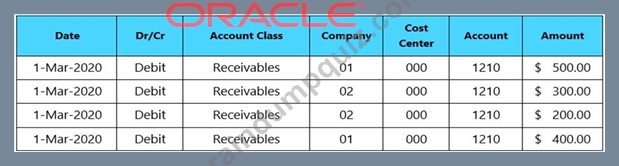
Which unearned revenue accounting entries will the feature generate?
- A. Credits of $900 and $500 for companies 01 and 02 respectively
- B. Credits of $900 and $600 for companies 01 and 02 respectively
- C. Credit of $900 and debit of $500 for companies 01 and 02 respectively
- D. Debits of $900 and $500 for companies 01 and 02 respectively
- E. Debit of $900 and credit of $500 for companies 01 and 02 respectively
Answer: E
NEW QUESTION 62
Which two items are required for customer invoicing? (Choose two.)
- A. Customers
- B. Remit-to-address
- C. Lockbox
- D. Customer Profile Class
Answer: C,D
NEW QUESTION 63
The auto-invoice program fails to complete. Subsequently, you notice a message in the log file regarding insufficient memory for processing.
To resolve this issue, by what factor should you multiply the maximum number of imported records (rounded to the nearest whole number)?
- A. 0
- B. 1
- C. 2
- D. 3
- E. 4
Answer: E
NEW QUESTION 64
If a customer has more than one transaction with the same number within a Lockbox transmission, then in which two receipt statuses are the receipts left? (Choose two.)
- A. On-account, if the Customer Account Number or MICR is provided and there are no matching recommendations
- B. Unidentified, if the Customer Account Number or MICR is not provided and there are no successful matching recommendations
- C. Applied, if the Customer Account Number or MICR number is provided
- D. Unapplied, if the Customer Account Number or MICR number is provided
Answer: B,D
NEW QUESTION 65
What are the three drilldown options available in the task pane for Receipt Remittance? (Choose three.)
- A. Lockbox Transmission History
- B. Correct Funds Transfer Errors
- C. Create Automatic Receipts
- D. Manage Receipt Remittance Batches
- E. Create Receipt Remittance Batch
Answer: C,D,E
NEW QUESTION 66
You have created two transactions with a 30-day payment term. The first transaction is on January 29, 2015 and the second transaction is on January 31, 2015. The invoice date is the same as the system date. Both transactions are assigned an unsigned receipt method that has the lead days set to 60, number of bills receivable rule set to one per customer, and the bills receivable maturity date rule set to latest.
Which statement is true when the create bills receivable batch is processed for a customer on January 31, 2015?
- A. A Bills Receivable is created with the issue date as January 31, 2015 and the maturity date as March 30, 2015.
- B. Two Bills Receivable transactions are created with the issue dates as January 29, 2015 and January 31, 2015.
- C. A Bills Receivable is created with the issue date as January 31, 2015 and the maturity date as February 28, 2015.
- D. A Bills Receivable is created with the issue date as January 31, 2015 and the maturity date as March 2, 2015.
- E. Two Bills Receivable transactions are created with maturity dates as March 30, 2015 and April 1, 2015.
- F. Two Bills Receivable transactions are created with the issue date and accounting date as January 29, 2015 and January 31, 2015, respectively.
Answer: E
NEW QUESTION 67
Identify the receivables system option that relates to customers.
- A. Automatic Site Numbering
- B. Receipt Method
- C. Default Country
- D. Reciprocal Customer
Answer: B,C
NEW QUESTION 68
A client rents equipment for special events. They have the following invoicing requirements: invoice must De entered and be due either immediately, or 20 or 10 days before the event. The Deferred Event Revenue Account for Rentals is to be credited at the time of invoice booking. After the events occur, the client wants all lines to debit the Deferred Event Revenue Account and credit the Event Revenue.
How can you meet this requirement?
- A. Create a Revenue Contingency with Revenue Policy as None, Contingency Primary Removal Event as Invoicing, and Optional Removal Event as Transaction Date, with Transaction Date being the Event Date.
- B. Create a Revenue Contingency with Revenue Policy as None and Contingency Primary Removal Event as Payment.
- C. Create a Revenue Contingency with Revenue Policy as Credit, Contingency Primary Removal Event as Milestone Billing, and Optional Removal Event as Fulfillment Date.
- D. Create a Revenue Contingency with Revenue Policy as None, Contingency Primary Removal Event as Contingency Expiration, and Optional Removal Event as Transaction Date, with Transaction Date being the Event Date.
Answer: B
NEW QUESTION 69
When importing Receivable transactions into Fusion Receivables, the Autoinvoice log gives the error message "Error: Item validation org not set up for the BU." What action should you take to solve the issue?
- A. Set up Item validation organization in Receivables System Options.
- B. Set up Item validation organization in Inventory Item.
- C. Set up Item validation organization in Inventory Org.
- D. Validate the Item validation organization in inventory Org.
Answer: A
NEW QUESTION 70
Your client processes many customer refunds on a regular basis and would like to have information about recent refunds (including their status) for analytical purposes.
What should you do to meet this requirement in an efficient manner?
- A. Create an Oracle Transactional Business Intelligence (OTBI) analysis.
- B. Run the predefined Transaction Details Report.
- C. Search in the Receivables "Manage Credit Memo Applications" page, then export results to Excel.
- D. Search in the Payables "Manage Payments" page, then export results to Excel.
Answer: A
NEW QUESTION 71
A customer calls the Accounts Receivables department and asks for the balance of all invoices that are due in the next 30 days. The customer also has a question about a specific invoice line.
As a Billing Specialist, which action would you take?
- A. Create an open debit memo.
- B. Search for open invoices on the Manage Transaction search page.
- C. Search for the information in the Review Customer Account Details user interface.
- D. Apply, reverse, or process the receipt.
Answer: C
NEW QUESTION 72
......
Oracle 1z0-1056-22 Exam Syllabus Topics:
| Topic | Details |
|---|---|
| Topic 1 |
|
| Topic 2 |
|
| Topic 3 |
|
| Topic 4 |
|
| Topic 5 |
|
| Topic 6 |
|
| Topic 7 |
|
Actual Questions Answers Pass With Real 1z0-1056-22 Exam Dumps: https://skillsoft.braindumpquiz.com/1z0-1056-22-exam-material.html