

[Aug-2024] 2V0-51.23 PDF Dumps Extremely Quick Way Of Preparation
Download 2V0-51.23 Dumps (2024) - Free PDF Exam Demo
To prepare for the VMware 2V0-51.23 exam, candidates can take advantage of various training resources such as VMware official training courses, online forums, practice exams, and study guides. With thorough preparation, candidates can pass the exam and achieve the VMware Horizon 8.x Professional certification, which is a valuable credential for IT professionals working with virtual desktops and applications.
Passing the VMware 2V0-51.23 exam leads to the VMware Certified Professional - Desktop and Mobility 2021 (VCP-DTM 2021) certification, which demonstrates that the candidate has the skills and expertise to manage and deploy VMware Horizon solutions. VMware Horizon 8.x Professional certification is highly valued by employers and can lead to better job opportunities and higher salaries. It also helps candidates to stay current with the latest VMware Horizon technologies and developments.
NEW QUESTION # 39
Refer to the exhibit.
Drag and drop the components on the left that are part of the logical architecture for a single-site deployment of VMware Horizon into their correct position in the diagram on the right.
Answer:
Explanation:
Explanation:
NEW QUESTION # 40
Which three steps are required to entitle user and groups to pools? (Choose three.)
- A. Navigate to Users and Groups > Entitlements > click on Entitlements > click on Add Entitlements, search for users and groups in the Users pane and add the desired desktop pool in the next pane Desktop Pools.
- B. Navigate to Inventory > Desktops > check mark a pool > click on Add Entitlement.
- C. Run the Active Directory entitlement script in the golden master, when preparing if for the pool.
- D. During the Pool creation the desired Active Directory OU for the VMs will be specified. This will automatically add the preconfigured associated user group to the Horizon entitlements.
- E. During pool creation in the entitlement pane, click on add, search for users and groups in the Active Directory, continue and finish the pool creation.
Answer: A,B,E
Explanation:
Explanation
To entitle users and groups to pools, you need to perform the following steps:
During pool creation in the entitlement pane, click on add, search for users and groups in the Active Directory, continue and finish the pool creation. This option allows you to entitle users and groups to a desktop or application pool at the same time as you create the pool3.
Navigate to Inventory > Desktops > check mark a pool > click on Add Entitlement. This option allows you to add entitlements to an existing desktop or application pool after you create the pool4.
Navigate to Users and Groups > Entitlements > click on Entitlements > click on Add Entitlements, search for users and groups in the Users pane and add the desired desktop pool in the next pane Desktop Pools. This option allows you to review and manage the entitlements for users and groups from a single location5.
The other options are not required or valid for entitling users and groups to pools. Running the Active Directory entitlement script in the golden master is not necessary as Horizon 8 automatically synchronizes with Active Directory domains that are configured in Horizon Console6. Specifying the desired Active Directory OU for the VMs during pool creation does not automatically add the preconfigured associated user group to the Horizon entitlements as you still need to select the users or groups from the search results7. References := 3: VMware Horizon 8 Documentation: Add Entitlements During Pool Creation 4:
VMware Horizon 8 Documentation: Add Entitlements After Pool Creation 5: VMware Horizon 8 Documentation: Review and Manage Entitlements 6: VMware Horizon 8 Documentation: Active Directory Requirements forHorizon Connection Server 7: VMware Horizon 8 Documentation: Create an Automated Desktop Pool
NEW QUESTION # 41
A Horizon Administrator is publishing an application which will be used by users across multiple Horizon pods and sites.
Which feature of Global Entitlements are beneficial to this scenario?
- A. Applications can be hosted from multiple pods but a user sees only a single icon.
- B. Users must be explicitly assigned access to each application in each pod.
- C. Users can pick which pod delivers the application at launch.
- D. Applications do not have to be explicitly published from each pod.
Answer: A
Explanation:
Global Entitlements in VMware Horizon allow for the aggregation of resources across multiple pods and sites into a single entitlement. This feature is particularly beneficial when publishing applications that are hosted across different pods, as it ensures that users see only one icon for the application, regardless of which pod it is hosted on, simplifying the user experience and administration of applications in a multi-pod Horizon environment.
NEW QUESTION # 42
Which two of the following are features of VMware Horizon Agent for Linux? (Choose two.)
- A. installation registration requirement
- B. USB redirection
- C. display protocol PCoIP
- D. location based printing
- E. session collaboration
Answer: B,C
Explanation:
Explanation
VMware Horizon Agent for Linux is a software component that enables Linux machines to be used as remote desktops or published applications in a Horizon environment. Horizon Agent for Linux supports several features that enhance the user experience and manageability of Linux desktops and applications, such as USB redirection, display protocol PCoIP, multiple-session mode, single sign-on, smart card authentication, and 3D graphics34. However, Horizon Agent for Linux does not support location based printing or session collaboration features that are available for Windows machines5. Also, Horizon Agent for Linux does not require installation registration as it automatically registers with the Connection Server when the viewagent service is started6. References := 3: VMware Horizon 8 Documentation: Horizon Agent for Linux 4: VMware Horizon 8 Documentation: Features Supported by Horizon Agent for Linux 5: VMware Horizon 8 Documentation: Features Not Supported by Horizon Agent for Linux 6: VMware Horizon 8 Documentation: Install Horizon Agent on a Linux Machine
NEW QUESTION # 43
What are the steps to create a custom role?
- A. In the navigation pane under the Settings section click on Administrators > Users and Groups > Add.Once the Add Role pane opens, add a name for the role and select the specific privileges.
- B. In the navigation pane under the Settings section click on Administrators > Roles and Permission > Users and groups > Add. Once the Add Role pane opens, add a name for the role and select the specific privileges.
- C. In the navigation pane under the Settings section dick on Administrators > Roles and Permission > Add.
Once the Add Role pane opens, add a name for the role and select the specific privileges. - D. In the navigation pane under the Settings section click on Administrators > Entitlements > Add. Once the add Role pane opens, add a name for the role and select the specific privileges.
Answer: C
Explanation:
Explanation
Roles and permissions are a way of controlling the access and actions of administrators and users in Horizon.
By default, Horizon provides two predefined roles: Administrators and Read Only Administrators. However, a high-level administrator can create custom roles with specific privileges to suit different needs and scenarios.
To create a custom role, the administrator needs to follow these steps:
In the navigation pane under the Settings section, click on Administrators > Roles and Permissions.
In the Roles and Permissions page, click on Add.
In the Add Role pane, enter a name for the role in the Role Name text box.
In the Privileges section, select the checkboxes for the privileges that you want to assign to the role. You can expand or collapse the categories to view or hide the sub-privileges. You can also use the Select All or Deselect All buttons to select or clear all the privileges in a category.
Click on Save to create the custom role.
The custom role will appear in the Roles and Permissions page, where you can edit or delete it as needed. You can also assign the custom role to users or groups in the Users and Groups page. References: [Create Custom Roles] and [VMware Horizon 8.x Professional Course]
NEW QUESTION # 44
To reduce the risk of users downloading malware to the corporate network, an administrator wants to allow end-users to open only intranet websites inside their virtual desktop. Additionally, the administrator wants to configure all other URLs to automatically open in a browser on the end-user's client machine.
Which steps should the administrator take to meet the requirements? (Choose two.)
- A. Disable the Allow External Website feature in Horizon Agent.
- B. Enable the URL Content Redirection feature in Horizon Agent.
- C. Configure group policy settings to indicate how Horizon Agent redirects the URL
- D. Enable the URL Content Redirection feature on the desktop pool settings.
- E. Enable secure website settings in the Global Settings Security menu.
Answer: B,C
Explanation:
Explanation
The URL Content Redirection feature allows administrators to configure specific URLs to open on the client machine or in a remote desktop or published application. This can help reduce the risk of users downloading malware to the corporate network, as well as improve the user experience and performance of certain web applications.
To meet the requirements of the scenario, the administrator needs to enable the URL Content Redirection feature in Horizon Agent when installing or upgrading it on the instant-clone desktops. This will allow Horizon Agent to send or receive URLs from Horizon Client, depending on the redirection direction. The administrator also needs to configure group policy settings to indicate how Horizon Agent redirects the URL.
Specifically, the administrator needs to enable agent-to-client redirection, which means that Horizon Agent sends the URL to Horizon Client, which opens the default application for the protocol in the URL on the client machine. The administrator also needs to specify which URLs are redirected from a remote desktop to a client, and which URLs are not redirected. In this case, the administrator needs to configure a whitelist of intranet websites that are allowed to open inside the virtual desktop, and a blacklist of all other websites that are automatically redirected to a browser on the client machine.
The other options are not relevant or sufficient for meeting the requirements. Disabling the Allow External Website feature in Horizon Agent will prevent users from accessing any external websites from their virtual desktops, which might not be desirable or practical. Enabling secure website settings in the Global Settings Security menu will not affect how URLs are redirected, but only how secure connections are establishedbetween Horizon components. Enabling the URL Content Redirection feature on the desktop pool settings will not work unless it is also enabled in Horizon Agent and configured with group policy settings. References: Configuring URL Content Redirection and [VMware Horizon 8.x Professional Course]
NEW QUESTION # 45
Refer to the exhibit.
An administrator is tasked with creating an instant clone pool for their sales department. During the creation of the pool the administrator saw that there is no golden image available, as seen in the exhibit.
Which two actions can an administrator take so that the golden image is showing up in the Golden Image selection window? (Choose two.)
- A. Login to the vSphere Client, select the Golden Image virtual machine and delete all snapshots.
- B. Login to the vSphere Client, select the Golden Image virtual machine and clone it to a new virtual machine.
- C. Login to the vSphere Client, select the Golden Image virtual machine and create a snapshot
- D. Refresh the Select Golden Image view and select the Golden Image.
- E. Login to the vSphere Client, select the Golden Image virtual machine and convert it to a template.
Answer: C,E
Explanation:
Explanation
The administrator can take two actions to make the golden image show up in the Golden Image selection window. First, they can login to the vSphere Client, select the Golden Image virtual machine and create a snapshot. This will make the golden image available in the selection window. Second, they can login to the vSphere Client, select the Golden Image virtual machine and convert it to a template. This will also make the golden image available in the selection window.
A golden image is a virtual machine that contains the operating system, applications, and settings that are required for an instant clone desktop pool. To create an instant clone desktop pool, the administrator must select a golden image and a snapshot from the vSphere inventory. The snapshot must be taken after installing and configuring the Horizon Agent on the golden image1. If there is no snapshot or no template available, the golden image will not show up in the selection window.
The other options are not correct for this scenario:
Login to the vSphere Client, select the Golden Image virtual machine and delete all snapshots. This option is not correct because deleting all snapshots will not make the golden image show up in the selection window. In fact, it will prevent the administrator from creating an instant clone desktop pool, as a snapshot is required for instant cloning2.
Refresh the Select Golden Image view and select the Golden Image. This option is not correct because refreshing the view will not change the availability of the golden image in the selection window. The administrator must create a snapshot or a template of the golden image before it can be selected.
Login to the vSphere Client, select the Golden Image virtual machine and clone it to a new virtual machine. This option is not correct because cloning the golden image to a new virtual machine will not make it show up in the selection window. The administrator must still create a snapshot or a template of the cloned virtual machine before it can be selected.
References:
Preparing a Golden Image Virtual Machine for Instant-Clones
Snapshot vmdk files of the golden image used to publish Instant clone ...
Create an Automated Instant-Clone Desktop Pool
Instant Clone Desktop Pools
[VMware Horizon 8.x Professional]
NEW QUESTION # 46
An administrator needs to enable Session Collaboration in the VMware Horizon environment. What will be used as a requirement to enable Session Collaboration?
- A. BLAST protocol
- B. floating Instant Clone pool
- C. PCoIP protocol
- D. dedicated Instant Clone pool
Answer: A
Explanation:
Collaboration is a feature that allows users to invite other users to join an existing Windows or Linux remote desktop session with both screen sharing and audio out features enabled. A remote desktop session that is shared in this way is called a collaborative session. The user that shares a session with another user is called the session owner, and the user that joins a shared session is called a session collaborator. A Horizon administrator must enable the Session Collaboration feature for the desktop pool or farm that contains the remote desktops that support collaboration.
One of the requirements to enable Session Collaboration is to use the VMware Blast display protocol for the remote desktops. VMware Blast is a protocol that provides high-performance, high-quality graphics and multimedia delivery over LAN or WAN networks. VMware Blast supports Session Collaboration by allowing multiple users to view and interact with the same remote desktop session simultaneously. Other display protocols, such as PCoIP or RDP, do not support Session Collaboration and will not allow users to share or join collaborative sessions.
Therefore, to enable Session Collaboration in the VMware Horizon environment, the administrator needs to use the BLAST protocol as a requirement. References: Configuring Session Collaboration, Sharing Remote Desktop Sessions, and [VMware Horizon 8.x Professional Course]
NEW QUESTION # 47
A senior Horizon administrator is tasked with enabling two-factor authentication for other Horizon administrators to login to the Horizon Console.
Which option will the administrator use that supports two-factor authentication?
- A. SAML
- B. Smart Card Authentication
- C. RADIUS
- D. RSA SecureID
Answer: C
Explanation:
RADIUS (Remote Authentication Dial-In User Service) supports two-factor authentication and can be integrated with VMware Horizon to secure administrative access to the Horizon Console. RADIUS servers authenticate users based on a combination of something they know (a password) and something they have (a token or mobile app-generated code), providing an added layer of security for administrative logins.
NEW QUESTION # 48
Which storage product allows the pooling of resources to create datastores in a software defined datacenter?
- A. VMware vSAN
- B. VMware Storage I/O Control
- C. VMware HCI Mesh
- D. VMware VMFS
Answer: A
Explanation:
Explanation
VMware vSAN is a storage product that allows the pooling of resources to create datastores in a software defined datacenter. VMware vSAN is a hyper-converged infrastructure solution that integrates compute, storage, and networking resources on industry-standard x86 servers. VMware vSAN aggregates local or direct-attached data storage devices to create a single storage pool shared across all hosts in the vSAN cluster.
VMware vSAN enables you to provision and manage storage from the VMware vSphere Web Client or the VMware vCenter Server Appliance Shell. VMware vSAN provides several benefits, such as lower total cost of ownership, simplified management, high performance, scalability, and availability12. References := 1:
VMware Horizon 8 Documentation: VMware vSAN Overview 2: VMware Horizon 8 Documentation: Benefits of Using VMware vSAN with Horizon 8
NEW QUESTION # 49
Drag and drop the Anywhere Workspace components on the left to their respective function on the right.
Answer:
Explanation: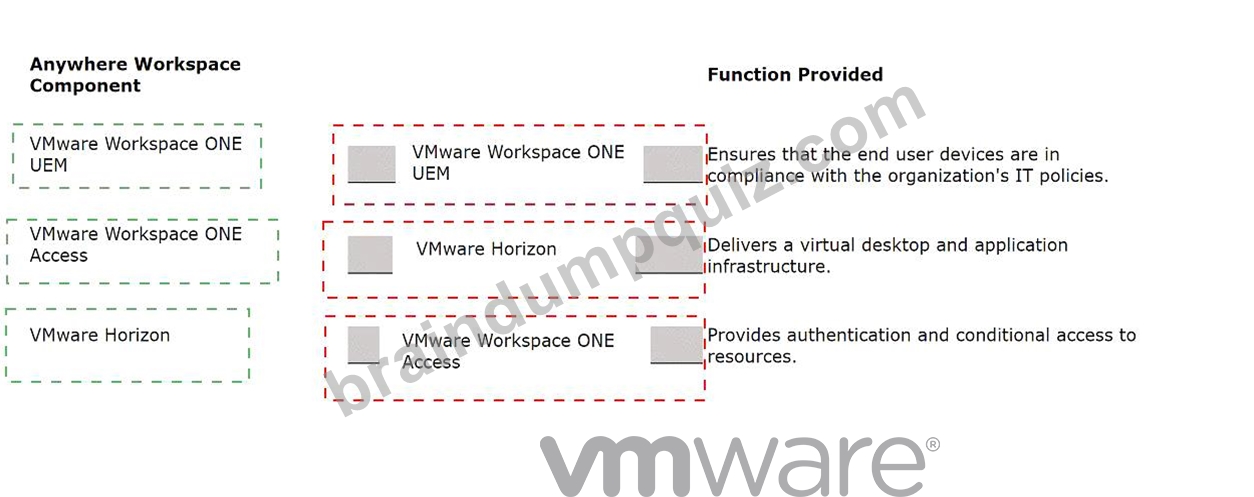
Explanation:
A screenshot of a computer program Description automatically generated
VMware Horizon is designed to deliver a virtual desktop and application infrastructure, providing IT with a modern, streamlined approach to deliver, protect, and manage Windows and Linux virtual desktops and applications while containing costs and ensuring that end users can work anytime, anywhere, on any device.
Horizon 8 supports flexible hybrid and multi-cloud deployment options and offers an optimized experience with unified communication and collaboration tools. The VMware Blast Extreme Protocol, included with Horizon 8, is a dynamic display protocol that delivers an immersive, feature-rich user experience across devices, locations, media, and network connections.
VMware Workspace ONE UEM (Unified Endpoint Management) is crucial for ensuring that end-user devices comply with an organization's IT policies. It manages and secures endpoints like smartphones, tablets, laptops, and desktops, streamlining operational tasks for IT while ensuring corporate data security.
VMware Workspace ONE Access facilitates secure and simplified access to enterprise applications, providing single sign-on capabilities and conditional access based on user authentication. This ensures that users can access the resources they need efficiently while maintaining the security of the organization's data and applications.
References:
For more information on VMware Horizon 8 and its capabilities, you can refer to VMware's official documentation and resources available at techzone.vmware.com, which provides a comprehensive overview of Horizon 8, including its architecture, components, and deployment scenarios.
Detailed insights into VMware Workspace ONE UEM and Workspace ONE Access can be found within VMware's product documentation and techzone resources, which offer guidance on implementing and managing these solutions as part of the Anywhere Workspace ecosystem.
NEW QUESTION # 50
An administrator needs to deploy an application to specific users in their instant-clone desktop environment with the following characteristics:
* The application needs to be updated very frequently.
* The application needs to be installed as soon as possible.
* The application is not multi-user aware.
Which solution would meet the requirements?
- A. VMware App Volumes
- B. VMware Dynamic Environment Manager
- C. VMware Horizon Published Application
- D. VMware ThinApp
Answer: A
Explanation:
Explanation
VMware App Volumes is a real-time application delivery system that allows administrators to assign applications to users and groups in Horizon. App Volumes uses virtual disks called packages to store and deliver applications. When a user logs on to a desktop, the App Volumes agent attaches the assigned packages to the desktop and merges them with the OS disk. The user can then access the applications as if they were natively installed.
App Volumes is a suitable solution for deploying an application to specific users in an instant-clone desktop environment with the following characteristics:
The application needs to be updated very frequently: App Volumes allows administrators to update applications in real time by using the update or push-image operations. These operations replace the existing packages with new ones that have the latest updates applied, without affecting the user data or settings. The updated packages are delivered to the users at the next login or refresh.
The application needs to be installed as soon as possible: App Volumes allows administrators to install applications quickly and easily by using a clean packaging system and capturing the application installation process. The resulting package can be assigned to users or groups immediately, without requiring any recomposing or rebooting of the desktops.
The application is not multi-user aware: App Volumes allows administrators to deliver applications that are not multi-user aware by using writable volumes. Writable volumesare user-specific virtual disks that store user-installed applications, data, and settings. Writable volumes can be attached to desktops along with application packages, and they can isolate the user-installed applications from the system-installed applications.
The other options are not suitable for meeting the requirements:
VMware Horizon Published Application: This option allows administrators to publish applications from RDS hosts to users in Horizon. However, this option requires a separate RDS infrastructure and licensing, and it does not support instant updates or writable volumes for user-installed applications.
VMware Dynamic Environment Manager: This option allows administrators to manage user profiles and policies in Horizon. However, this option does not deliver or update applications, and it does not support writable volumes for user-installed applications.
VMware ThinApp: This option allows administrators to package applications into portable executables that can run on any Windows system without installation. However, this option requires a separate packaging process and licensing, and it does not support instant updates or writable volumes for user-installed applications.
References: App Volumes Architecture, Updating Applications in Real Time, Writable Volumes Overview, and [VMware Horizon 8.x Professional Course]
NEW QUESTION # 51
A user is complaining that each time they logon they need to change the settings for the e-mail client.
Which three options can an administrator deploy to make sure the user's settings are being saved? (Choose three.)
- A. Roaming Profiles
- B. Flexible profiles
- C. VMware Dynamic Environment Manager
- D. VMware App Volumes Writeable Volumes
- E. Persona Management
Answer: C,D,E
Explanation:
The user's problem is that their settings for the e-mail client are not being saved across sessions. This means that their user profile, which contains their personal data, settings, and preferences, is not being preserved or synchronized properly. To solve this problem, the administrator can deploy one or more of the following options to manage user profiles in Horizon:
VMware App Volumes Writable Volumes: This option allows users to store user-installed applications, data, and settings on a disk independent of the VM. Writable volumes can be attached to desktops along with application packages, and they can isolate the user-installed applications from the system-installed applications. Writable volumes can also be configured to capture specific files and registry keys by using the snapvol.cfg policy file. This option can help users retain their e-mail client settings on a writable volume that is attached to their desktop at each login.
Persona Management: This option allows administrators to manage user profiles by using a remote repository that stores user profiles. Persona Management synchronizes the user profile between the remote repository and the local desktop at login, logout, and at regular intervals during the session.
Persona Management also supports profile redirection, which allows administrators to redirect certain folders in the user profile to a network share or a writable volume. This option can help users access their e-mail client settings from the remote repository or the redirected folder at each login.
VMware Dynamic Environment Manager: This option allows administrators to manage user profiles and policies by using a central share that stores user configuration files. Dynamic Environment Manager captures and applies user settings and preferences based on conditions and triggers, such as location, device, or application launch. Dynamic Environment Manager also supports profile archives, which allow administrators to back up and restore user profiles on demand or on schedule. This option can help users apply their e-mail client settings from the central share or the profile archive at each login.
The other options are not valid options for managing user profiles in Horizon:
Roaming Profiles: This option is a native Windows feature that allows users to access their user profile from any computer in a domain by storing it on a network share. However, this option is not recommended for Horizon because it can cause long login times, profile corruption, and data loss due to its synchronous and overwrite behavior. Roaming profiles are also incompatible with instant clones and linked clones.
Flexible profiles: This option does not exist in Horizon or Windows. It might be confused with Flex Profiles, which is a third-party product from Liquidware that provides profile management solutions similar to Dynamic Environment Manager.
References: Writable Volumes Overview, Configuring User Profiles with Horizon Persona Management, VMware Dynamic Environment Manager Overview, and [VMware Horizon 8.x Professional Course]
NEW QUESTION # 52
Drag and drop each Horizon console predefined role on the left to its matching function on the right.
Answer:
Explanation:

Administrator: Performs all administrative functions and applies to an Access Group.
Inventory Administrator: Performs all desktop, session, and pool-related operation.
Local Administrator: No rights to manage Cloud Pod or the Global Data Layer.
NEW QUESTION # 53
Which two of the following are features of VMware Horizon Agent for Linux? (Choose two.)
- A. installation registration requirement
- B. USB redirection
- C. display protocol PCoIP
- D. location based printing
- E. session collaboration
Answer: B,C
NEW QUESTION # 54
An organization with an existing Windows 2012 R2 Server RDSH farm decided to move to Windows Server
2019 as their new standard. Order the steps that need to be taken by the administrator to deploy a RDS desktop pool with this new standard.
Answer:
Explanation:
Explanation:
To deploy a RDS desktop pool with the new standard of Windows Server 2019, the steps should be ordered as follows:
Prepare the Windows Server 2019 golden image. This is the first step because you'll need a prepared OS image to base your RDS desktop pool on.
Add an Automated Farm. Once your golden image is ready, you can set up an automated farm for the RDS desktop pool.
Add a RDS desktop pool. Using the automated farm and the prepared golden image, you can now add the RDS desktop pool.
Entitle AD users and/or groups. With the RDS desktop pool in place, the next step is to give Active Directory (AD) users and groups the necessary entitlements to access the desktops.
Launch Horizon Client and verify access to RDS desktop. As the final verification step, launch the Horizon Client to ensure that you can access the newly created RDS desktop pool and that everything is functioning as expected.
So, the sequential order is: Prepare the Windows Server 2019 golden image -> Add an Automated Farm -> Add a RDS desktop pool -> Entitle AD users and/or groups -> Launch Horizon Client and verify access to RDS desktop.
NEW QUESTION # 55
......
Enhance your career with 2V0-51.23 PDF Dumps - True VMware Exam Questions: https://skillsoft.braindumpquiz.com/2V0-51.23-exam-material.html