

Pass Your Exam Easily! CPHQ Real Question Answers Updated on Nov 29, 2025
Actual Questions Answers Pass With Real CPHQ Exam Dumps
NEW QUESTION # 95
Based on this matrix, which of the following ideas should the team address first?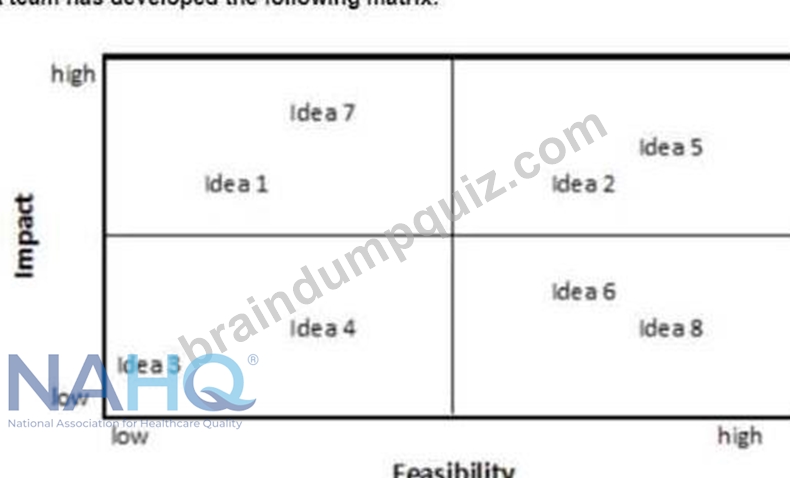
- A. 2 and 5
- B. 6 and 8
- C. 1 and 7
- D. 3 and 4
Answer: A
Explanation:
Based on the matrix provided, ideas 2 and 5 should be addressed first because they are in the quadrant that represents both high impact and high feasibility. Prioritizing ideas that are both highly feasible and likely to have a significant impact ensures that the organization can quickly and effectively implement changes that will yield the most benefit.
High Impact and High Feasibility: Ideas in this quadrant are typically the most promising because they are not only achievable (high feasibility) but also expected to produce meaningful improvements (high impact).
Strategic Prioritization: Addressing these ideas first allows the team to generate quick wins, which can build momentum and support for further quality improvement efforts.
Comparison to Other Options:
A: 1 and 7: High impact but low feasibility-these ideas might be more challenging to implement and could require more resources or time.
B: 3 and 4: Low impact and low feasibility-these ideas are neither easy to implement nor likely to have a significant effect, making them lower priorities.
D: 6 and 8: High feasibility but low impact-while these ideas are easier to implement, their impact might be minimal, so they should not be the primary focus initially.
Reference: NAHQ materials on prioritization in quality improvement emphasize the importance of focusing on initiatives that combine high impact with high feasibility to optimize resource use and maximize outcomes.
NEW QUESTION # 96
The CAHPS (Consumer Assessment of Healthcare Providers and Systems) program is a multiyear public- private initiative to develop standardized surveys of patients' experiences with ambulatory and facility-level care.
Healthcare organizations, public and private purchasers, consumers, and researchers use CAHPS results to:
- A. All of the above
- B. Compare and report on performance
- C. Improve quality of care
- D. Access the patients-centeredness of care
Answer: A
NEW QUESTION # 97
The preferred culture in promoting patient safety
- A. promotes learning from mistakes and fosters collaboration.
- B. uses anonymous reporting and audits standards.
- C. fosters collaboration and uses anonymous reporting.
- D. auditsstandards and promotes learning from mistakes.
Answer: A
Explanation:
The preferred culture in promoting patient safety is one that promotes learning from mistakes and fosters collaboration. This is because a culture that promotes learning from mistakes encourages a non-punitive environment where individuals feel safe to report errors and near misses. This openness allows for the identification of systemic issues that can be addressed to prevent future errors1.
On the other hand, fostering collaboration is crucial in patient safety as it encourages open communication and teamwork among healthcare professionals. Collaboration ensures that all team members can contribute their expertise to patient care, which can lead to improved patient outcomes23.
References:
Clinical nurse competence and its effect on patient safety culture: a systematic review1 Patient safety culture: a systematic review by characteristics of Hospital Survey on Patient Safety Culture dimensions2 Key drivers of promoting patient safety culture from the perspective of3
NEW QUESTION # 98
Which of the following characteristics best describes a learning organization?
- A. adaptability, systems thinking, willingness to challenge assumptions
- B. compliant, data rich, committed support of the organization's leader
- C. scholarship, valued autonomy, fiscal discipline
- D. passion, quality control, intolerance of disruptive thought
Answer: A
Explanation:
A learning organization is characterized by its ability to continuously evolve and improve by being adaptable, employing systems thinking, and being willing to challenge existing assumptions. These characteristics foster an environment where continuous learning and improvement are embedded in the culture.
Adaptability: A learning organization quickly adapts to changes in the environment, technology, and patient needs. This flexibility allows it to stay ahead in a dynamic healthcare landscape.
Systems Thinking: This approach involves understanding the organization as a whole, recognizing interconnections and interdependencies within the system, and addressing problems with a holistic perspective.
Willingness to Challenge Assumptions: A learning organization encourages questioning the status quo and re-evaluating traditional practices, which drives innovation and improvement.
Comparison to Other Options:
A:compliant, data-rich, committed support of the organization's leader describes an organization focused on compliance rather than learning.
C:scholarship, valued autonomy, fiscal discipline emphasizes individual expertise and financial control rather than collective learning.
D:passion, quality control, intolerance of disruptive thought suggests a rigid environment, which is contrary to the open, flexible nature of a learning organization.
Reference: NAHQ resources on learning organizations stress the importance of adaptability, systems thinking, and a culture of continuous questioning and improvement in fostering a sustainable, high- quality healthcare organization.
NEW QUESTION # 99
The best way a healthcare organization can measure whether it is meeting its goals and targets is to compare its
performance:
- A. With other healthcare organizations of its status
- B. Against itself over time
- C. Benchmarking
- D. With the world's top healthcare organizations
Answer: C
NEW QUESTION # 100
In order to make effective long-term changes, performance Improvement emphasizes the need to study and understand
- A. outcomes.
- B. standards.
- C. statistics.
- D. processes.
Answer: D
Explanation:
* Performance improvement (PI) is the continuous study and improvement of processes with the intent to better services or outcomes, and prevent or decrease the likelihood of problems, by identifying areas of opportunity and testing new approaches to fix underlying causes of persistent/systemic problems or barriers to improvement1.
* PI is based on the assumption that most problems are related to the processes rather than the people who perform them2. Therefore, studying and understanding the processes that deliver the services or outcomes is essential to identify the root causes of problems, the gaps between current and desired performance, and the potential solutions to improve them34.
* PI uses various methods and tools to analyze and measure processes, such as flowcharts, process maps, cause-and-effect diagrams, Pareto charts, histograms, control charts, run charts, and scatter diagrams5. These tools help to visualize the steps, inputs, outputs, and variations of a process, and to monitor and evaluate its performance over time6.
* PI also uses various models and frameworks to guide and accelerate improvement work, such as the Model for Improvement, Plan-Do-Study-Act (PDSA) cycles, Lean, Six Sigma,and Total Quality Management (TQM)7. These models and frameworks help to define the aim, the measures, and the changes for improvement, and to test and implement them in a systematic and iterative way8.
* Therefore, in order to make effective long-term changes, PI emphasizes the need to study and understand the processes that produce the services or outcomes, as this will help to identify and address the sources of variation, waste, and inefficiency, and to achieve better quality, safety, equity, value, and system sustainability9 . References: 1: QAPI Description and Background | CMS 2: Basics of Quality Improvement | AAFP 3: How to Improve: Model for Improvement | Institute for Healthcare Improvement 4: Performance Management and Quality Improvement - CDC 5: [Tools for Quality Improvement | NAHQ] 6: [Quality Improvement Tools and Methods | Agency for Healthcare Research and Quality] 7: [Quality Improvement Models and Frameworks | NAHQ] 8: [Quality Improvement Essentials Toolkit | Institute for Healthcare Improvement] 9: [Healthcare Quality and Safety Workforce Report: New Imperatives for Quality and Safety Mean New Imperatives for Workforce Development | NAHQ] : [The Financial Case for Quality as a Business Strategy | NAHQ] : [Tools for Quality Improvement | NAHQ] : [Quality Improvement Tools and Methods | Agency for Healthcare Research and Quality] : [Quality Improvement Models and Frameworks | NAHQ] : [Quality Improvement Essentials Toolkit | Institute for Healthcare Improvement] : [Healthcare Quality and Safety Workforce Report: New Imperatives for Quality and Safety Mean New Imperatives for Workforce Development | NAHQ] : [The Financial Case for Quality as a Business Strategy | NAHQ] : Tools for Quality Improvement | NAHQ : Quality Improvement Tools and Methods | Agency for Healthcare Research and Quality
NEW QUESTION # 101
Because of their detail and straightforward design, patient registries are a powerful source of quality improvement
data. Registries usually are specialty or procedure specific. For instance:
- A. Acute myocardial infraction
- B. Patient's bile test
- C. Enrollment in disease management program
- D. Total joint replacement
Answer: A
NEW QUESTION # 102
Experts on delivering superior customer service suggest that healthcare organizations adopt the following principle/s:
- A. Hire service-savvy people. Aptitude is everything, people can be taught technical skills
- B. Maintain a focus on facilities
- C. Help staff cope better is a stressful atmosphere
- D. Establish high standards of customer service
Answer: A,D
NEW QUESTION # 103
When allocating limited resources to meet strategic objectives, management decisions should be driven by
- A. accreditation standards.
- B. outcome data.
- C. local competition.
- D. consultant recommendations.
Answer: B
Explanation:
When allocating limited resources to meet strategic objectives, management decisions should be driven by outcome data. This is because outcome data provides evidence-based results that reflect the effectiveness and impact of a particular strategy or intervention. By focusing on outcome data, management can ensure that resources are being used in the most effective and efficient manner to achieve the desired results. This approach aligns with the principles of healthcare quality, which emphasize the use of data to inform decision- making and improve performance.
References:
Resource allocation is the process of identifying and assigning available resources to an initiative. Effective allocation of resources helps maximize the impact of project resources while still supporting your team's goals.
Gathering and recording as much information as possible is the key to making good resource allocation decisions. In short, knowing everything you possibly could about your resources, their availability, and the projects in most need of them lets you effectively match needs with resources.
What Is Resource Allocation? Here's How to Allocate Resources [2024] * Asana Resources | Project planning
| What is resource allocation? Learn how ... What is resource allocation? Learn how to allocate resources Julia Martins January 15th, 2024 8 min read Summary Project managers and teams can struggle to make balanced resource allocation decisions, often opting for too much or too little. But the key to navigating this delicate balance is continuous adjustment and real-time responsiveness to project needs. This approach ensures that resources are optimally utilized, preventing both surplus and shortfall and steering towards project success with precision and efficiency.
NEW QUESTION # 104
A nursing director for a unit in a cancer hospital Is reviewing and assessing outcomes data in the followingscatter diagram: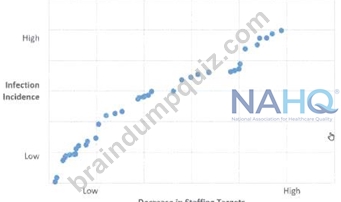
The relationship between the incidence of infection and the decrease in staffing targets is
- A. weak and positive.
- B. strong and positive.
- C. weak and negative.
- D. strong and negative.
Answer: D
Explanation:
The scatter diagramshows that as the decrease in staffing targets becomes more significant (moving right on the horizontal axis), the incidence of infection goes up (moving up on the vertical axis). This indicates a negative relationship because as one variable increases, the other one decreases. The relationship appears to be strong because the points lie closely to an imaginary line that slopes upwards from left to right, which suggests a consistent trend across the data points.
References:In healthcare quality improvement, it is critical to use data to inform decision-making. Scatter diagrams are a common tool used for this purpose. The NAHQ Healthcare Quality Competency Framework emphasizes the importance of analyzing and utilizing data in decision-making, as indicated in the Performance and Process Improvement domain. A strong negative relationship in this context could indicate that decreased staffing levels are associated with higher infection rates, which is a significant finding for a nursing director assessing outcomes and considering quality improvement initiatives.
NEW QUESTION # 105
After discharge, most patients with a mental health diagnosis have not been compliant with follow-up visits.
Which of the following Is the best way to Improve patient compliance?
- A. Communicate to noncompliant patients that appointments should be kept.
- B. Initiate a process where the discharge planners call patients prior to the follow-up visit
- C. Include handouts in the discharge documents on the Importance of keeping follow-up appointments.
- D. Benchmark with other facilities in the area to determine the rate of patient compliance.
Answer: B
Explanation:
According to the National Association for Healthcare Quality (NAHQ), one of the core competencies of healthcare quality professionals is patient safety, which includes ensuring effective transitions of care and reducing preventable readmissions12.
One of the strategies to achieve this goal is to improve patient compliance with follow-up visits, which can help monitor patient outcomes, prevent complications, and provide continuity of care34. Among the four options given, the best way to improve patient compliance is to initiate a process where the discharge planners call patients prior to the follow-up visit. This is because:
A phone call can serve as a reminder for the patient to keep the appointment, as well as an opportunity to address any barriers or concerns that the patient may have34.
A phone call can also help establish rapport and trust between the patient and the discharge planner, which can increase patient satisfaction and adherence4.
A phone call can also allow the discharge planner to confirm the patient's understanding of the discharge instructions, medication regimen, and follow-up plan, and to provide any additional education or support that the patient may need34. The other options are less effective because:
Benchmarking with other facilities in the area to determine the rate of patient compliance may provide some insight into the current performance and best practices, but it does not directly address the specific needs and preferences of the individual patient5.
Including handouts in the discharge documents on the importance of keeping follow-up appointments may increase the patient's awareness and knowledge, but it may not be sufficient to motivate the patient to act on the information, especially if the patient has low health literacy, cognitive impairment, or mental health issues.
Communicating to noncompliant patients that appointments should be kept may sound authoritative and judgmental, which may alienate the patient and reduce their willingness to cooperate. Instead, a patient- centered and empathetic approach that acknowledges the patient's challenges and preferences may be more effective.
Reference: 1: [NAHQ Code of Ethics] 2: [NAHQ HQ Principles] 3: The Importance of Patient Follow-Up | MagMutual 4: The Importance of Patient Follow-Up and Service Recovery 5: [The Financial Case for Quality as a Business Strategy]: [Utilization of Improvement Methodologies by Healthcare Quality Professionals During the COVID-19 Pandemic]: [Understanding the Evolving Landscape of Healthcare Quality]: https://nahq.org/about-nahq/code-of-ethics/: https://nahq.org/products/hq-principles/:
https://nahq.org/resources/the-financial-case-for-quality-as-a-business-strategy-2/:
https://nahq.org/resources/journal-for-healthcare-quality/utilization-of-improvement-methodologies-by- healthcare-quality-professionals-during-the-covid-19-pandemic/: https://nahq.org/news- media/news/understanding-the-evolving-landscape-of-healthcare-quality/
NEW QUESTION # 106
Which of the following is true regarding critical values?
- A. specific to nursing units
- B. determined by the organization
- C. defined by law
- D. provided by accrediting agencies
Answer: B
Explanation:
Critical values are specific test results that fall significantly outside the normal range and may indicate a life-threatening situation. These values are determined by the organization based on clinical judgment and the specific context of the healthcare setting. Each organization is responsible for defining what constitutes a critical value for various tests, ensuring that these values are communicated promptly to the responsible clinician.
Defined by law (A): Critical values are not universally defined by law; they are established by individual organizations based on their clinical needs and practices.
Provided by accrediting agencies (C): While accrediting agencies may provide guidelines on how to manage critical values, they do not define the specific values.
Specific to nursing units (D): Critical values are not specific to nursing units but are applicable across the organization and require prompt communication.
Reference
NAHQ Body of Knowledge: Critical Values in Laboratory Management
NAHQ CPHQ Exam Preparation Materials: Managing Critical Values in Healthcare
NEW QUESTION # 107
Familiarity with terms describing the psychometric properties of survey instruments and methods for data collection
can help an organization choose a survey that will provide it with credible information for quality improvement. There
are two different and complementary approaches to assessing the reliability and validity of a questionnaire. Which of
the following are out of those approaches?
- A. Both A and C
- B. Cognitive testing
- C. Technical excellence testing
- D. Psychometric testing
Answer: A
NEW QUESTION # 108
In successful implementation of performance improvement programs, use of a single improvement methodology
across all improvement initiatives is critical to facilitating a cohesive and consistent approach to improvement within
the organization. An organization can develop improvement methodologies internally or can adopt them from
external sources. Which of the following components is related to this strategy?
- A. Selection and use of a performance improvement methodology
- B. Staff understanding
- C. Establishment of a performance improvement oversight entity
- D. Establishment of partnership with key stakeholder
Answer: A
NEW QUESTION # 109
An emergency department's quality Improvement report for the first quarter showed the following data: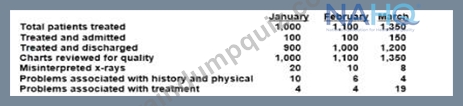
What was the approximate overall problem rate for March?
- A. 1%
- B. 2%
- C. 15%
- D. 18%
Answer: B
NEW QUESTION # 110
Which of the following regulatory agencies oversee development of electronic clinical quality measures (eCQMs)?
- A. DNV GL Healthcare
- B. Centers for Medicare and Medicaid Services (CMS)
- C. The Joint Commission (TJC)
- D. Occupational Safety and Health Association (OSHA)
Answer: D
NEW QUESTION # 111
To promote staff engagement In a new Initiative, educators should focus on staff
- A. who want to advance In the organization.
- B. attitudes of business as usual.
- C. who appear resistant to change.
- D. perceptions of the benefits of change.
Answer: D
Explanation:
To promote staff engagement in a new initiative, it's crucial to focus on staff perceptions of the benefits of change123. This involves communicating the value and benefits of the new initiative to the staff, and how it will improve their work or the outcomes for patients12. Staff are more likely to engage with a new initiative if they perceive it as beneficial and worthwhile23. This can be achieved through clear communication, education, and providing proof that new practices will be worthwhile3. It's also important to create a culture that empowers staff to achieve positive change2.
References:
https://www.bmj.com/content/368/bmj.m872
https://hbr.org/2022/02/3-ways-hospitals-can-boost-worker-engagement
NEW QUESTION # 112
A healthcare quality professional Is assisting an organization with evaluating patient safety actions that will prevent errors of omission. Which of the following systems will most likely be effective?
- A. a warning system that Is contiguous to the task and cues that the Individual Is about to Initiate the wrong intervention
- B. a reminder system that Isinclose proximity to the task and provides sufficient information about what needs to be done
- C. a proactive risk assessment system that Integrates with the task and automatically notifies the risk manager
- D. a detection system that notifies the team when an error has occurred and provides a checklist for mitigation measures
Answer: B
Explanation:
Errors of omission can lead to delayed or missed diagnosis1. In the context of healthcare quality, these errors are often preventable and can be mitigated through various systems and strategies23.
Option A, a reminder system that is in close proximity to the task and provides sufficient information about what needs to be done, aligns with the strategies to prevent errors of omission. This system serves as a proactive measure to ensure that necessary actions are taken and important steps are not missed. It provides healthcare professionals with timely and relevant information, thereby reducing the likelihood of errors of omission1.
Option B, a warning system that is contiguous to the task and cues that the individual is about to initiate the wrong intervention, while useful, is more aligned with preventing errors of commission (doing something wrong) rather than errors of omission (failing to do something right).
Option C, a proactive risk assessment system that integrates with the task and automatically notifies the risk manager, is also a valuable tool in healthcare quality. However, it is more focused on identifying and managing risks rather than preventing errors of omission.
Option D, a detection system that notifies the team when an error has occurred and provides a checklist for mitigation measures, is a reactive measure. While it is crucial for mitigating the impact of errors, it does not directly prevent errors of omission.
Therefore, based on the information available, option A would most likely be the most effective system in assisting an organization with evaluating patient safety actions that will prevent errors of omission231.
NEW QUESTION # 113
The initial step in clinical pathway development is review of
- A. provider input.
- B. continuous quality improvement methods.
- C. patient education materials.
- D. data for targeted population.
Answer: D
Explanation:
The initial step in clinical pathway development is crucial to ensure that the pathway is relevant, evidence- based, and aligned with the needs of the patient population it intends to serve. The first step is to review and analyze data specific to the targeted population (Answer C). This involves collecting and examining clinical, demographic, and epidemiological data about the patient group for whom the pathway is being designed. This data review helps to identify common diagnoses, treatment outcomes, complications, and variations in care, which will inform the development of a pathway that is both relevant and effective.
The other options are important elements in the development and implementation of a clinical pathway, but they occur later in the process:
* Patient education materials (A) are developed after the clinical pathway has been established to ensure that patients understand their care plan.
* Continuous quality improvement methods (B) are applied after the pathway has been implemented to monitor its effectiveness and make necessary adjustments.
* Provider input (D) is crucial throughout the pathway development but comes after the initial data review when creating or refining the clinical pathway based on practical considerations and clinical expertise.
References:
* National Association for Healthcare Quality (NAHQ) - Certified Professional in Healthcare Quality (CPHQ) Study Materials.
* NAHQ Clinical Pathways Development Guidelines.
* Continuous Quality Improvement in Clinical Pathways, NAHQ Documentation.
NEW QUESTION # 114
Licensing and accrediting bodies have relied heavily on structural measures of quality not only because the measures
are relatively stable and thus easier to capture but:
- A. They reliably indentify providers who are cheap
- B. They reliably identify providers who demonstrably la means to deliver high quality care
- C. They can never la the means to deliver high quality care
- D. They reliably identify physicians
Answer: B
NEW QUESTION # 115
The focus of Lean methodology is a "ba to basics" approach that places the needs of customer first through five steps.
Which of the following is NOT out of those steps?
- A. Define value as determined by the customer
- B. Make value identifying steps
- C. Let the customer pull the product
- D. Identify the value stream
Answer: B
NEW QUESTION # 116
......
NAHQ CPHQ (Certified Professional in Healthcare Quality Examination) Certification Exam is a professional certification exam that is designed to test the knowledge and skills of healthcare professionals in the field of healthcare quality. CPHQ exam is offered by the National Association for Healthcare Quality (NAHQ) and is recognized as the gold standard in healthcare quality certification.
New CPHQ Dumps - Real NAHQ Exam Questions: https://skillsoft.braindumpquiz.com/CPHQ-exam-material.html